
Introduction
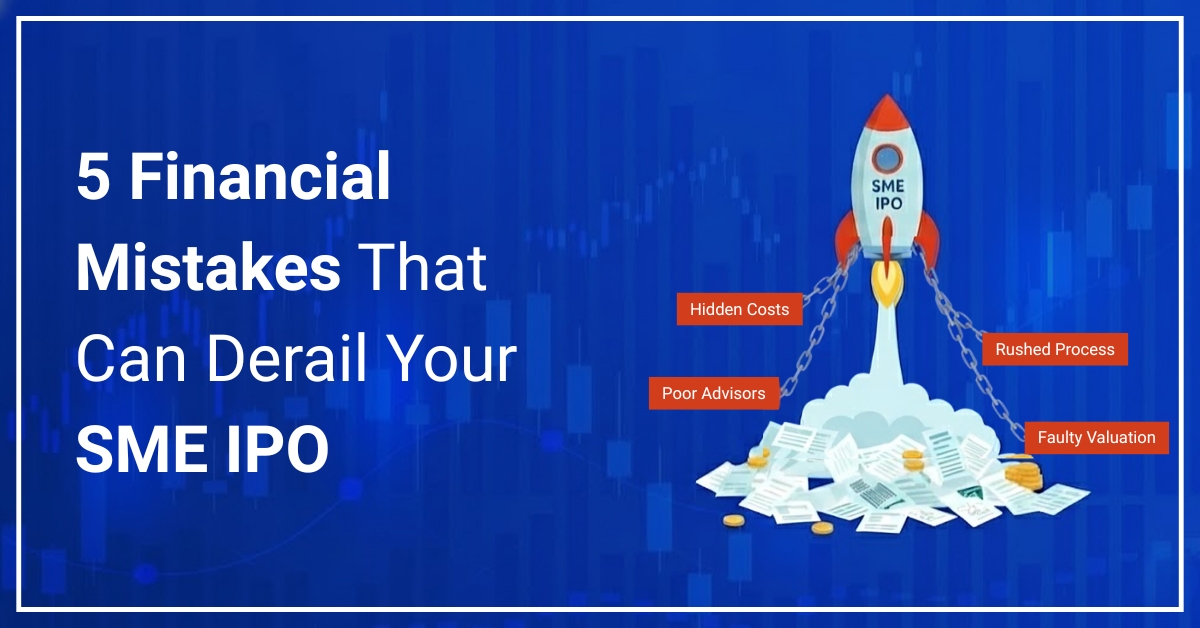
IPO of SMEs is a radical juncture that every small or medium enterprise would take when going public. The idea of raising funds, becoming known to the market, and becoming credible to the investors is thrilling. The road is however full of financial traps that can derail even well-intentioned companies. According to the real-life case studies and the analysis of the experts, the following are the five most serious financial errors that SME entrepreneurs make when going through the IPO process – and how to prevent them.
Error 1: Low-estimating Hidden Costs and Budget Overruns
Underestimating the actual cost of an IPO is one of the most destructive financial mistakes that SME founders commit. Although most entrepreneurs consider the fees of merchant bankers and statutory compliance costs, they tend to ignore some other hidden costs that may inflate the overall cost immensely.
The Hidden Cost Breakdown
The highest expenditure category is the fees of merchant bankers. In the case of SMEs, the fees are usually 25-30 lakhs of the offerings below 25 crore to 35-50 lakhs of 25-50 crore IPOs. This is however, only the tip of the iceberg. Most firms find that their historical financial records need to be recreated: a long and costly process that costs auditor fees of 5-10 lakhs, document scanning (2-3 lakhs), back-reconciliation services (3-5 lakhs), and additional advisory fees that no one can predict (10+ lakhs). Also, merchant bankers tend to charge termination fees (50% of negotiated fees) in case the IPO is cancelled, something most entrepreneurs do not think about until it is too late.
The Real Impact
IPO can eat up 7 10 percent of your target amount to be raised. Assuming the IPO target is 50 crore, you might incur 3.5 to 5 crore and not a single cheque will be received by an investor. Most SMEs find themselves in mid-way that they have reached the limit of their budgets and either have to cut timelines (resulting in quality problems) or postpone the IPO (incurring further carrying costs).
Prevention Strategy
Starting the process of upgrading your financial systems and record keeping 2-3 years prior to launching your IPO as opposed to scrambling to recreate documents along the way. This proactive planning removes the expensive back-reconciling and audit extensions. Also, negotiate clear fee structures with merchant bankers in advance and clarify termination provisions to prevent the unexpected.
Error 2: Hurrying the IPO Process and Comprising Key Stages
The other common financial mistake is to squeeze the IPO process into 6-9 months when a 12-18 months period is the advisable one. This rush causes cascade financial issues.
The reason behind the high cost of Compressed Timelines
Rushing results in documentation errors, incomplete financial audits and regulatory demands to re- submit all of which prolongs timelines in an unpredictable manner. In compression, the advisory fee is marked up in proportion of 10-20 lakhs as the professionals work overtime or when several teams are engaged to meet unnatural deadlines. Also regulators will look more critically at hasty submissions and this may lead to Observations (formal queries) which are very expensive to respond to and lead to further delays.
The Domino Effect
A regulatory delay can be initiated by a single:
- Extra consultations with advisors (₹250,000 to500,000 per cycle)
- Prolonged merchant banker engagement charges ( 3-8 lakhs per month of delay ).
- Sluggish investor roadshows (which fall out of momentum in tight timetables)
- Possible inefficient pricing because of market condition fluctuations.
Prevention Strategy
Arrange a realistic 12-18 month IPO process between IPO-readiness evaluation and listing day. Start financial audit trails, documentation and strengthening governance at least 1824 months prior to target listing date. This enables the regulatory bodies to go through the submissions at their own pace, lessens the re-submission, and provides you with leeway to react to market forces.
Error number 3: Faulty Company Valuation (Overpricing or Underpricing)
Miscalculating the valuation of their company is one of the most significant financial errors that SMEs commit; that is, either overvaluing their company to gain a better subscription or undervaluing it to gain a fast subscription. Both end up destroying investor confidence and shareholder value.
The Overvaluation Trap
Most entrepreneurs join the IPO process with unrealistic valuation that is not supported by financial fundamentals. In the course of due diligence by investors, inflated claims are detected very fast resulting in low subscription or post- listing underperformance. Overstated valuation also leads to regulatory demands to re-assess, which demand:
- Re-engagement of a valuation expert (₹1015 lakhs)
- Long roadshow schedules (₹1015 lakh extra expense)
- Prospectus re-printing and re-filing ( 5-8 lakhs)
- Post-listing reputational damage
The Undervaluation Trap
On the other hand, taking a low valuation so as to have fast subscription implies that founders are relinquishing equity unnecessarily. When your 50 crore company is priced at 40 crore because of overly conservative estimates, you have cost investors 10 crore in value permanently the ownership portion of your company.
What Investors are Really After
Established investors consider SMEs on the basis of:
- Stable increase in revenue in the past 3-5 years.
- Profitability in the operations within the past 3 financial years (at least 2 years).
- Business model scalability.
- Competitive position in the market.
- Quality of management and track record.
Prevention Strategy
Hire third-party, independent valuation professionals at the beginning of the IPO preparation. These practitioners employ objective market-based techniques (DCF analysis, peer benchmarking, comparable company analysis) to come up with defensible valuations. Your valuation is based on a documented financial performance and market research, which will avoid regulatory delays and skepticism among investors.
Error 4: Insufficient Audit Compliance and Governance Preparation
Compliance with finances cannot be compromised during the process of IPO, but most of the entrepreneurs in SMEs prepare their financial and governance structures only partially. This translates to expensive regulatory fines and time delays.
The Compliance Burden
Any SME intending to do an IPO has to possess three years of audited annual financial statements upon which they can file with the exchange. The auditor is expected to declare that the records are true to the business performance and internal controls are adequate to avoid fraud and errors. In addition to financial audits, SMEs should develop effective corporate governance framework such as having independent directors in the board, active audit committee, and well defined roles and responsibilities.
Unknown Indirect Costs of Non-Compliance
In the event SME audit compliance is below par, SMEs experience:
- Further audit cycles (₹5-10 lakhs).
- Governance lapses (₹1050 lakhs in worst-case situations) fined by the regulatory authorities.
- Prolonged SEBI vetting.
- Skepticism of the quality of management and governance by investors.
- The possibility of rejection of the IPO application.
Real-World Impact
When an SME joins the IPO process with poor documentation, it may later realize that old financial records do not match the regulatory requirements during the process. Thereupon auditors need to settle multiple years of differences, give revised audit opinions, or ask management to restate finances, all of which are extremely expensive and reputation-damaging measures.
Prevention Strategy
Upgrade governance and compliance infrastructure 1218 months prior to your IPO. Hire an SME IPO consultant India with a specialization of regulatory alignment in order to perform a pre-IPO compliance audit and locate gaps in time. Empower your board of directors, including members who are independent, form audit and remuneration committees and formalize all governance decisions. This initial capital investment helps avoid the expenses attributable to the regulatory delays and makes your company investor-ready.
Error 5: Weak Advisor Choice and Inadequate Professional Advice Investment
Most of the SME founders seek to reduce their expenses by using inexperienced advisors or limiting the levels of professional contact. This fake economy regularly backfires in a dramatic fashion, leading to paperwork mistakes, missed deadlines of compliance, and missed chances of engaging investors.
The Cost of Cheap Guidance
A 10 lakh saving on low quality advisory services is likely to result in 50 or more lakh cost overruns due to downstream complications. Inexperienced advisors may:
- Misses regulatory requirement deadlines, and has to be extended.
- Completion or inaccuracy of documentation of files, which leads to SEBI Observations.
- Offer weak valuation frameworks, which lead to a pushback by investors.
- Do not pay much attention to corporate governance gaps until it becomes a critical issue.
- Be unable to create attractive investor stories, which lowers subscriptions.
The Under-Subscription Cost that Dwells
A weak investor traction is a common problem with an SME that does not enlist the services of good SME IPO consultants. Under-subscription is caused by poor investor relations planning, weak roadshow strategy, or weak growth stories, which forces either price cut (diluting proceeds and founder value), or IPO cancellation (all the preparation costs and face lost).
What Quality Advisors Really Do
The experienced firms in India provide SME IPO consultant services:
- IPO-readiness measurement of financial health, business model, and governance.
- Compliance roadmaps that guarantee compliance with SEBI requirements and the stock exchange requirements.
- Professional documentation such as Draft Red Herring Prospectus (DRHP) and compliance reports.
- Objective methodology valuation and structuring.
- Roadshow implementation and investor relations strategy.
- Post-IPO compliance services that guarantee further compliance with regulations.
Prevention Strategy
Hire experienced professionals early in the process of IPO. You will need to spend 2-3 per cent. of your IPO target on quality advisory (a 50 crore IPO will require a 1-1.5 crore budget on professional guidance). Collaborate with SME IPO consultants with proven track records, extensive regulatory knowledge and investor contacts. Note: bad advice is much more expensive than good advice.
Summing Up: Investing in Financial Discipline is Your IPO Foundation
Financial discipline is usually the difference between a successful SME IPO and a calamity that costs a lot of money. When entrepreneurs fail to calculate all the costs involved, go ahead of schedule, do improper valuations, overlook regulations, or compromise on professional advice, they are bound to suffer budget overruns, regulatory delays, investor skepticism, and low proceeds.
In comparison, SMEs that invest in appropriate financial preparations, hire professional advisors at an early stage, give realistic timeframes, base their valuations on objective analysis, and focus on compliance establish a strong base to succeed in the IPO. The 1-2 crore spent in quality financial planning and advisory services is usually paid back in 5-10 crore of downstream cost savings and high IPO valuations.
Your IPO is not merely a fundraising event but a move into the realm of a public company and an indelible change of your mode of operation. An IPO financial discipline process sets the tone of investor confidence, post listing credibility and shareholder value in the long term. These five pitfalls are to be avoided and your SME IPO will place your company on the path of sustainable growth.